Everest Base Camp (EBC) with 3 High Passes
Trip Duration:
19 Nights / 20 Days
Max Altitude:
5550 m
Activities:
Trekking
Start Point:
Kathmandu
Ending Point:
Kathmandu
Region:
Everest
Trip Grade:
Diffcult
Meals:
Kathmandu include 3 Breakfast, Trekking include 19 Breakfast, 17 Lunch and 16 Dinner
Accommodation:
Hotel / Tea House Lodge on the trek
Best Season:
Spring( March April May) & Autumn ( September Octuber November )
Group Size:
Minimum 2 person
Trips Overview
The Everest Base Camp Trek with Three High Passes is one of the most adventurous and complete trekking experiences in the Himalayas. This challenging journey takes you deep into the Khumbu region, combining the classic route to Everest Base Camp with the thrilling crossings of three high mountain passes: Kongma La (5,535 m), Cho La (5,368 m), and Renjo La (5,360 m).
The journey begins with a scenic mountain flight to Lukla, followed by a gradual trek through traditional Sherpa villages, including the vibrant town of Namche Bazaar. As you ascend, you will explore ancient monasteries such as Tengboche Monastery and experience the rich culture and hospitality of the Sherpa community.
The trek leads you to the iconic Everest Base Camp and offers a rewarding hike to Kala Patthar, one of the best viewpoints for spectacular sunrise views over Mount Everest and surrounding peaks like Lhotse, Nuptse, and Ama Dablam.
Crossing the three high passes is the ultimate highlight of this trek, offering breathtaking panoramic views, remote landscapes, glacial lakes, and a true sense of adventure. The route also takes you to the beautiful Gokyo Lakes and the stunning viewpoints of Gokyo Ri.
This trek is physically demanding and best suited for experienced trekkers seeking a challenging and rewarding Himalayan adventure, combining natural beauty, cultural richness, and high-altitude exploration.
Trips Highlights
- Hike across three adventure high passes Kongma La ( 5535m.), Cho La (5420m.) and Renjo La (5340m.) of Everest region.
- Hike to the remote and untouched valley of Everest region.
- Scenic flight to and from Lukla.
- Visit Everest Base Camp and climb Kalapather (5545m)
- Remarks view of Khumbu Ice-fall.
- Explore the Himalayan Sherpa settlement.
- Breathtaking views of the eight thousand above meters peak including Mount Everest.
Include
- Meeting and Assistance on Arr./Dep. at the Airport or Hotel by The Crampon for Nepal Travel Representatives.
- All transfers and tours on A/C vehicle as per group size
- Nonalcoholic welcome drinks on arrival at hotel
- Single / Double / Twin sharing room on Breakfast basis in Kathmandu
- Monument entrance fees during mentioned city tour
- English, Spanish, or any other major language spoken by an experienced local tour guide while on the tour in Kathmandu
- Flight: Ramechap / Lukla / Ramechap (Spring and Autumn) or Kathmandu/Lukla/Kathmandu
- Trekking permits: National Park Fee & another permit
- Duffel Bag to carry luggage, First aid medicine kit
- Twin / Dormitory room in lodge/guest house inclusive of 3 simple meals, breakfast, lunch & dinner. Tea twice daily. Please note that each meal is served as a single serving.
- Official licensed English-speaking trek Sherpa guide,
- One Porter for two trekkers basis to carry luggage (Permit max 9 kg. per trekker) Trekking permits
- One assistant Sherpa guide if group size is above 6 pax
- Trek crew salary, insurance, food & accommodation
- Heli rescue arrangement in case of health issue according to your insurance policy
- Farewell dinner.
- All presently applicable government tax and service tax
- Only include Bed and Breakfast in Kathmandu Hotel
Exclude
- International air fares to and from Kathmandu
- Excess of baggage on domestic/international flight
- Nepal entry visa fee; pay in cash at Kathmandu airport.
- Any meal not mentioned in the program
- Photography fees inside the monument (if applicable)
- Charging electronic devices and Wi-Fi on the trek
- Hot shower charges during the trek (if applicable)
- Extra costs due to natural and political causes such as landslides, unrest, snow, strikes, etc.
- Personal Trekking gear, Sleeping bag etc.
- All personal expenses, such as laundry, telephone, food and drinks, etc., are not mentioned in the itinerary.
- Tips for guides, porters, drivers, restaurants, etc. (customary)
- Personal travel insurance, including helicopter rescue in case of emergency (recommended to possess)
- Due to any reason, expenses of any extra transfer, hotel accommodation, and other services abandoning the trekking or expedition trip before or after scheduled.
- Charging electronic devices and Wi-Fi on the trek
- Any other service not mentioned in the column of services includes.
Trips Itinerary
The flight into the Himalayas offers breathtaking views of the major peaks Mt. Dorje Lakpa (6,966 m),Mt. Ganesh (7,422 m), Mt. Purbi Chhyachu (6,637 m), Mt. Langtang (7,227 m), etc. (weather permitting),
taking you directly into the Himalayan capital of Kathmandu.
After immigration formality on arrival, as you exit the airport terminal you will be greeted and welcome by The Crampon for Nepal Travel personal & transferred to your hotel, Spend the rest of the day at leisure for personal activities following your program briefing or you may familiarize with the narrow lively, and endless streets around Thamel town (Touristic center), where you will find all kinds of good restaurants, ATMs and exchange money, full of typical Nepali handicrafts, fine jewelry, clothing, and trekking gear stores.
Max Altitude: 1330 m
Accommodation: Hotel
Flight Duration: 45 mins
Trek Duration: 5 hrs
After breakfast, we take an enchanting 25-minute flight takes you offering breathtaking views of lush green and White Mountains, will reach the Tenzing-Hillary Airport at Lukla. This is one of the most beautiful air routes in the world culminating in a dramatic landing on a hillside surrounded by high mountains peaks. Upon arrival at Lukla, you will meet our other Sherpa crew members and after some further arrangements, the trail start through the prosperous village of Lukla until we reach Phakding.
Due to acclimatization, we will have short trek up to Phakding, later we can visit the nearby monastery.
Max Altitude: 2652 m
Accommodation: Trekking Lodges
Meal: Breakfast Lunch Dinner
Trek Duration: 6 hrs
The trek through a beautiful pine forest, the trail leads us along the Dudh Koshi River passing by some suspension bridges; one of them is the famous Hillary Suspension Bridge. On the way we will have first glimpse of Mt. Thamserku (6618 m). We will pass through the beautiful villages of Benkar, Chumoa, and Monjo, followed by check post and entrance to Sagarmatha National Park.
At the last we will pass by Jorsale before reaching Namche Bazaar. The trail climbs through the forests and bridges until we reach the confluence of the Dudh Koshi and Bhote Koshi rivers. After a final steep ascent of two hours, we will have first sight of Mt. Everest peering over the Lhotse-Nuptse ridge where we can stop to catch the view.
Finally, we will reach to Namche Bazaar, a gateway to Mt. Everest and main trading and Sherpa village of this region.
Max Altitude: 3440 m
Accommodation: Trekking Lodges
Meal: Breakfast Lunch Dinner
In Namche Bazar: Rest Day for “acclimatization”, but you are suggested to explore short hiking to Thame, Khunde or exploring Namche Bazaar itself. Namche Bazar is the main business center of the Everest (Khumbu) region and has government offices; where you will find ATMs, Internet cafes,shops, restaurants, a bakery and a colorful market on Friday evening and Saturday. take a visit to Tourist Visitor Center near the headquarter of the Sagarmatha National Park to observe an assortment of things related to the first Everest ascenders, Sherpa culture and learn about the various plant and animal life of the Everest region.
Max Altitude: 3440 m
Accommodation: Trekking Lodges
Meal: Breakfast Lunch Dinner
Trek Duration: 5 hrs
After breakfast in Namche, we start our trek towards Tengboche enjoying superb view of Mt. Everest, Nuptse, Lhotse, Ama Dablam and close up view of Thamserku. Our trek follows on the gradual trail with few ups and down overlooking magnificent view of the great Himalaya.
Along the way we can spot wild lives like pheasant, musk deer, or a herd of Himalayan Thar. The trail goes gradually down up to Kyangjuma. The path eventually reaches Sanasa which is the major trail junction to Gokyo valley and Everest Base Camp.
The track then follows through the pine forests and after we cross the prayer flags festooned bridge over Dudh Koshi River, we reach Phunki Tenga, a small settlement with a couple of teahouses and a small army post amidst the alpine woods. After having a relaxed lunch at Phunki Tenga we then have a little tough climb steep up through the pine forests while before we reach Tengboche.
Tengboche is a great place for close up views of Ama Dablam, Nuptse and Everest and it has a biggest Buddhist Monastery all over in Khumbu region. Overnight stay at lodge in Tengboche.
Max Altitude: 3860 m
Accommodation: Trekking Lodges
Meal: Breakfast Lunch Dinner
Trek Duration: 6 hrs
With a mountain as a backdrop, the monastery in Tengboche looks spectacular more in the morning. We click pictures of the monastery and the sceneries around and as usual start the day journey on a merry note. We choose the upper trail for better views to visit Pangboche village and its ancient Monastery. We pass through several Chortens and Mani walls and small villages. We enjoy lunch with fantastic close-up views of Ama Dablam.
In the afternoon, go north to Pheriche or take the eastward trail beneath the towering north face of Ama Dablam. From here onwards the walk is fairly moderate as we enter the Imja Valley.
The valley ahead with begin to open up as we approach the confluence of the Lobuche River, we descend into the river and begin the last and steepest climb of the day up to Dingboche.
On arrival in Dingboche, we enjoy the beautiful array of fields enclosed by stone walls to protect the barley, buckwheat and potatoes from the cold winds and grazing animals. Overnight at lodge in Dingboche.
Max Altitude: 4360 m
Accommodation: Trekking Lodges
Meal: Breakfast Lunch Dinner
Trek Duration: 5 hrs
Today after breakfast, our walk takes off at a cool pace with only about 3-4 hours hike to Chhukung. The trek goes through Imja Khola valley and sublime alpine landscapes, and some stone walled fields. On the trail we will also have spectacular mountain views of Mt. Lhotse, Mt.Ama Dablam
and Island Peak. Imja Tse has a splendid pyramid shape with its step rock and icy south face.
Chhukung is a great place to explore the glacier and massive snow laden mountains all around the place. Overnight at an elevation of 4750m. where the air gets thinner.
Max Altitude: 4750 m
Accommodation: Trekking Lodges
Meal: Breakfast Lunch Dinner
This extra day for acclimatization is good for our bodies to cope with the heights before doing the passes that begin with Kongma La (5535m). Today we will do a day trip to Nagarjun Hillock. Nagarjunis a hill located on the glands of the Chhukung valley directly above Dingboche.
After breakfast we will head to Nagarjun. It may takes about 5 hrs to reach Nagarjun. From Nagarjun we can see the great views of Lobuche east, Lobuche west, Lobuche peak, Thamserku, Kangtega and Ama Dablam. We could even see Makalu, the world’s fifth highest mountain. We then descend back to Chhukung. Overnight at a cosy teahouse lodge.
Max Altitude: 4750 m
Accommodation: Trekking Lodges
Meal: Breakfast Lunch Dinner
Trek Duration: 7 hrs
We start at the break of the day from Chhukung as we have to capture the highest pass of the trip today. We carry plenty of water and some snacks and a packed lunch as there is no tea shops on the way. We really enjoy the remoteness of the area and absolute nature !! Just after some walk there are
great views of Island Peak valley and jagged ridge of Amphu Lapcha. Ascending along the east side of Niyang Khola valley, we turn west and walk through the sloppy stony trail. We enter a wide basin dotted with small frozen lakes. The trail rises over loose screed gaining the Kongma La about 5 hours we leave Chhukung.
Upon reaching the top, we seen cairn wrapped in prayer flags, marks of the pass. Behind us is the landscape of icy lakes ahead down of which is the Khumbu Glacier. The final descent is the toughest stage of the trek today, upon climbing the moraine on the far side , the trail turns north through
Khumbu Glacier which culminates at Lobuche. Overnight in Lobuche.
Max Altitude: 4940 m
Accommodation: Trekking Lodges
Meal: Breakfast Lunch Dinner
Trek Duration: 8 hrs
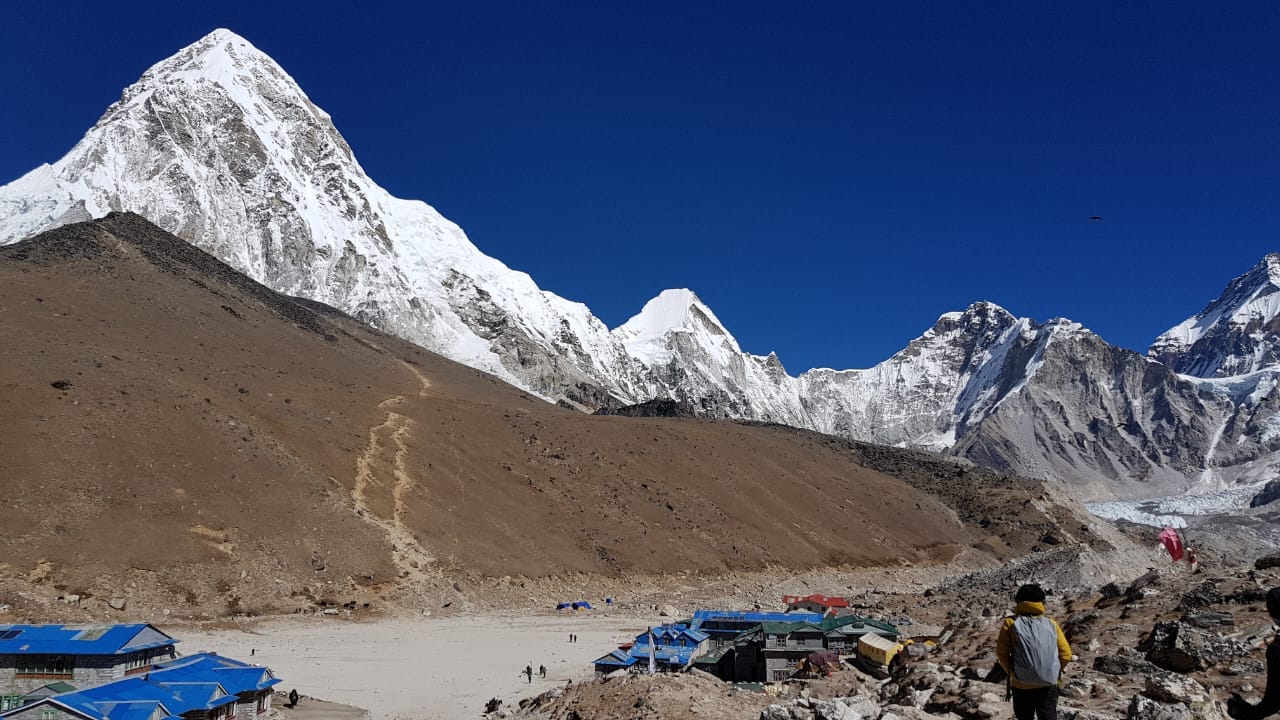
Today after a steamy breakfast at lodge, we climb through meadows and moraine stones steps to reach Gorakshep, by either climbing to Kalapatthar or heading to Everest base camp. We suggest that you make a beeline for Everest base camp. By the way, from Everest base camp we do not see Mount Everest. However, from Kala Patthar, we get to see the entire south face of Mt. Everest and well known peaks nearby; this also includes great sights of the skyline of the Tibet plateau. Overnight at the height of 5170 m.
Max Altitude: 5170 m
Accommodation: Trekking Lodges
Meal: Breakfast Lunch Dinner
Trek Duration: 8 hrs
Today early in the morning we begin our trek to get remarkable views of the sunshine gleaming on the face of Everest from Kalapatthar. We are surrounded by darkness and cold temperatures of approximately -10 to -15 degree celcius in the morning. It is testing hike to Kalapatthar Because of the high altitude and shirvering cold. On reaching the peak of Kalapatthar, we will have unbelievable views of the mountain that you will see only once in your lifetime.
Max Altitude: 4940 m
Accommodation: Trekking Lodges
Meal: Breakfast Lunch Dinner
Trek Duration: 4 hrs
After breakfast, we will be heading towards Dzongla. The trek is about 3 to 4 hours.The route goes beside the river bed off stream. The trail heads in southeastern side which provides us a lovely view of towering heights of Ama Dablam and Kangtega- Thamserku. Similarly, Taboche looms is just a
few steps ahead. The ancient village, Pheriche village is also clearly visible during our trek. We will go through mound in Chukpi Lhara which will bid a good bye with fresh memories. Chola Lake spreadedbelow Mt. Cholatse is a view to observe on our route. The lakes will give us a fresh view until we descend a basin. Then we have climb up a spur and then have to descend a steeply way down to another board basin. Then after an hour walk we reach Dzongla. Meanwhile we will have to cross a bridge in this an hour walk. We will stay overnight in Dzongla at local guest house.
Max Altitude: 4830 m
Accommodation: Trekking Lodges
Meal: Breakfast Lunch Dinner
Trek Duration: 8 hrs
Dzongla-Gokyo is our next trek route which is about 7-8 hours walk. After our breakfast we will start our trek from Dzongla. Just after we step out of the hotel we have the splendid view of Cholatse.
We have to head towards western side of Dzongla. The trip today is little harder than earlier. The path descends; we will go beside the stream coated with ices on some places. About after an hour we will reach to the top of basin. From there we can have the enchanting view of the Chola lake and the Ama Dablam which appears over a range of mountains in the south and Cholatse soars on the west.
The journey from here seems to be little difficult as climbing the incline which is steepy made more difficult by boulders and may we have to scramble. We may have to bear a little risk as the rocks can be glazed by ice.
After we reach at the top we can see prayer flags, strung across cairns, flapping in the strong wind. The exting view will take your breath out. The path from here is little easy as we just have to descend but it can be found dangerous if rocks are gazed by the ice. So we need to be careful. Then we reach to Thangnak, and as we pass the village we will be welcomed by shiny Mountain view.
After a short walk, we will be at the edge of Ngozumpa glacier. Then after from other side of the glacier we can have the view of beautiful Gokyo Lake. On the edge of the Gokyo Lake, Gokyo village is situated.
It is our final destination where we stay for a night.
Max Altitude: 4800 m
Accommodation: Trekking Lodges
Meal: Breakfast Lunch Dinner
On the day, we will take rest in Gokyo village and have the view of enchanting sites of Gokyo village. If the day is favourable then we can climb Gokyo Ri enjoy the view of clear Everest Region.The Gokyo region not only provides you the view of enchanting sites of Gokyo peak but also adds an
opportunity viewing series of six lakes.
You can also see Thonak Thso Lake ( fourth lake) and Ngozuma Thso Lake ( fifth lake). The fourth lake of this series has high cliff and peaks raising above the lake just about 3 kms north. We can have the view of the turquoise coloured water of the lake. Moreover we can climb on the hill and get amazing view of Mt. Cho-Oyu,Mt.Gyachung Kang,Mt. Everest, Mt. Lhotse, Mt. Nuptse and Mt. Makalu.
Cho-Oyu base camp situated beyond fifth lake, from where we can have the closer view of Mt. Cho- Oyu and Gyachung Kang. Cho-Oyu base camp and the biggest glacier of the world, the Ngazumpa Glacier is the view to preserve from the nortern part of the fifth lake. If possible we may even head to the sixth lake too.
Then we return to Gokyo village and spend overnight at lodge.
Max Altitude: 4800 m
Accommodation: Trekking Lodges
Meal: Breakfast Lunch Dinner
Trek Duration: 8 hrs
After having one day rest and some sightseeing in Gokyo, our next trek will be Marlung via Renjo La pass. We need to be little hurry to head towards Marlung as there is no place to stay at Renjo La.
After we leave Gokyo valley, we will turn to Renjo La trail by Dudh Pokhari. After a walk of about 3 hourswe can reach to Renjo La where we can see highest peak in the world Mt. Everest( 8848m), Mt Lhotse (8516m), Mt Cholastse (6440m) and Mt Tabuche (6542m) smiling at us.
We can have the similar view here in Renjo La as we had from Gokyo Ri where third Gokyo lake and Gokyo village can be seen beneath Ngozumpa glacier. Continuing our journey, the trail steps down a stone staircase and then need to scramble to reach the south bank of a small dazzling lake named as Angladumba Tsho. There might be presence of ice on the way while moving down the trek.
We can see Relama Tsho and Renjo La lake during our walk. Then we walk down narrow valley to Lumde where we may find a hotel but it is often found closed. After we reach Lumde, we can reach Marlung almost after
an hour on the east of the Bhote Koshi. We will stay overnight at Marlung 4210m.
Max Altitude: 4210 m
Accommodation: Trekking Lodges
Meal: Breakfast Lunch Dinner
Trek Duration: 6 hrs
After stay one night in Marlung, we will desending to Namche Bazaar. We will start our journey in the early morning from Marlung. We will following the route used to be used by the Tibetan traders.
We cross Bhote Koshi river and step downwards Taranga. The path goes through the valley of Langmuche Khola. This khola ( stream) drains from the glacier lake named Dig Tsho. This lake was once brust in 1985 causing floods affecting Dudh Koshi valley and Thame.
Thame is a beautiful village. We can get dew hotels in the village. Moreover we can see some eye-catching view of some mountain namely Thamserku, Katenga, Kusum Kangguru, etc.
There situates a famous Gompa situated some fields farther on the west hill. This Gompa is believed to be established some 325 years ago. This Gompa features three big images of Chenregis (Avalokiteswara), Guru Rinpoche, Buddha Sakyamuni. If you visit on may then you can experience the fun
of colourful Mani Rimdu festival featuring colourful mask dances as this festival is held only on may.
Moving forward we cross a bridge and reach to Samde. Again we descend downwards to Thamo village.
We can see a monastery called Khari Gompa which is a nunnery being home to some nuns and monks.
Leaving this village behind we come to the world’s highest hydroelectric power station built on Austrian help. Then after we come to Purthe after a short walk where you can find is Laudo Monastery which is run by Kopan monastery of Bauddha in Kathmandu and is popular among the westerners for Buddhist study and meditation center.
Then after we ultimately reach Namche Bazaar. We can see some Gompas
on the way to Namche Bazaar colourful prayers flags, and Mani stones. Overnight at Namche Bazaar (3440m).
Max Altitude: 3440 m
Accommodation: Trekking Lodges
Meal: Breakfast Lunch Dinner
Trek Duration: 6 hrs
Following the morning breakfast, we continue our trek to Lukla along the Dudh Koshi river, the trails goes steepy downward with rocky terrain. Even though, we are walking the same route, we feel completely different then the before. We pass through the rhododendron, pine and oaks forest and several snow covered peaks. Overnight at lodges in Lukla.
Max Altitude: 2840 m
Accommodation: Trekking Lodges
Meal: Breakfast Lunch Dinner
Flight Duration: 45 mins
Upon arrival, you will be met at the domestic airport and transferred to Kathmandu by our representative.
The rest of the day is free for leisure and personal activities. You may explore the vibrant and bustling streets of Thamel, where you will find a wide selection of restaurants, traditional Nepali handicrafts, fine jewelry, clothing, and trekking gear shops.
Max Altitude: 1330 m
Accommodation: Hotel
Meal: Breakfast
Visit Kathmandu Durbar Square, a UNESCO World Heritage Site and one of the most important historical places in the city. It is like an open-air museum with many temples, courtyards, and old palaces built by the Malla kings.
Explore Kumari Ghar, where the Living Goddess (Kumari) lives. Sometimes, she appears at the window to greet visitors. See Hanuman Dhoka, the old royal palace where Nepalese kings were crowned. At the entrance, there is a statue of the monkey god Hanuman.
Nearby, you can also see the large statue of Kal Bhairab and several other beautiful temples.
Secondly we visit Swayambhunath Stupa, a UNESCO World Heritage Site with a history of over 2,500 years. It sits on a hilltop and offers great views of the city. The area is also known for its many monkeys, so it is often called the Monkey Temple.
This sacred site is a mix of both Buddhist and Hindu traditions, with many shrines, chaityas, and monasteries around. Despite the 2015 earthquake, the stupa remains strong and is still one of Kathmandu’s most loved landmarks.
You can see beautiful carvings, smell incense and butter lamps, and experience a peaceful spiritual atmosphere. Visitors and devotees walk around the stupa (a ritual called circumambulation) while spinning prayer wheels set into its base. The area is also surrounded by traditional houses of priests and monks.
Finally we visit Boudhanath Stupa, one of the largest and most peaceful stupas in the world and a UNESCO World Heritage Site. It is a very important place for Tibetan Buddhism.
The stupa stands tall with its white dome and the eyes of Buddha watching in all directions, symbolizing wisdom and compassion. Every day, monks and visitors walk around it, spinning prayer wheels and offering prayers.
The area around Boudha is calm and spiritual, filled with monasteries, small shops, and the soft sound of chanting. It is a perfect place to feel peace, culture, and devotion in a simple and beautiful way.
Max Altitude: 1330 m
Accommodation: Hotel
Meal: Breakfast
Breakfast, In the morning free for personal activities, we can explore the narrow lively and endless streets of Thamel town where we will find all kinds of good restaurants, full of typical Nepali handicraft, fine jewelry, clothing and trekking gear store, later at the arranged time, transfer to the airport for final departure.
We wish you a safe flight and hope to serve you back in near future. End of Service.
Meal: Breakfast
Preparing the right packing list for the Everest Base Camp Trek is essential for a safe, comfortable, and enjoyable journey to the Himalayas. The trek takes you through varying altitudes and temperatures, so having the appropriate clothing, gear, and equipment is crucial for success. Below is a comprehensive checklist of what to bring for your Everest Base Camp (EBC) Trek.
Clothing
- Base Layers: Moisture-wicking thermal tops and bottoms
- Insulating Layers: Fleece jacket or down jacket for warmth
- Outer Shell: Waterproof and windproof jacket and pants
- Trekking Pants: Lightweight, quick-drying pants
- T-shirts: Breathable, moisture-wicking shirts (long and short sleeves)
- Gloves: Inner thermal gloves and outer waterproof gloves
Footwear
- Trekking Boots: Waterproof, well-broken-in boots with good ankle support
- Camp Shoes or Sandals: For resting in the evenings at teahouses
- Gaiters: To protect from snow, dust, or small rocks
Backpack and Gear
- Main Duffel Bag: Provided by most trekking agencies for porters
- Daypack (30–40L): To carry essentials like water, snacks, and camera
- Gaiters: Rated for –15°C (can be rented in Kathmandu)
- Trekking Poles: Adjustable poles for stability on steep terrain
- Rain Cover: For both backpack and daypack
Trips FAQs
The Everest Base Camp with Three High Passes Trek is the most comprehensive and challenging trekking adventure in the Everest region. In addition to visiting Everest Base Camp (5,364 m) and the iconic viewpoint of Kala Patthar (5,545 m), the route crosses the three legendary Himalayan passes—Kongma La Pass (5,535 m), Cho La Pass (5,420 m), and Renjo La Pass (5,360 m). This extended itinerary takes trekkers through remote valleys, pristine alpine lakes, glaciers, and traditional Sherpa villages, offering a more immersive and less crowded experience than the classic Everest Base Camp trek.
The Everest Three High Passes Trek is considered one of Nepal’s most demanding teahouse treks and is recommended for trekkers with excellent physical fitness and previous multi-day hiking experience. Daily walks typically range from 6 to 9 hours, with several steep ascents and descents over rugged mountain terrain. Crossing high-altitude passes above 5,300 meters requires endurance, proper acclimatization, and mental resilience. Although the trek does not involve technical mountaineering, the combination of altitude, distance, and challenging trails makes it significantly more difficult than the standard Everest Base Camp Trek.
The trek includes three spectacular Himalayan mountain passes: Kongma La Pass (5,535 m), Cho La Pass (5,420 m), and Renjo La Pass (5,360 m). Each pass offers a unique trekking experience and breathtaking panoramic views of Mount Everest, Lhotse, Makalu, Cho Oyu, Ama Dablam, Nuptse, and numerous surrounding peaks. Along the way, trekkers also cross glaciers, high alpine valleys, and remote mountain landscapes that are inaccessible on the classic Everest Base Camp route, making this one of the most rewarding trekking circuits in the Himalayas.
Yes. Unlike the standard Everest Base Camp Trek, the Everest Three High Passes Trek is best suited for trekkers who already have experience with multi-day mountain trekking or high-altitude hiking. The route demands long walking days, steep mountain passes, and sustained physical effort at elevations exceeding 5,500 meters. Preparing with cardiovascular training, strength exercises, and endurance hikes before your trip will greatly improve your chances of completing the trek safely and comfortably.
Reviews

Nature’s Untouched Masterpiece
Upper Dolpo is a hidden gem of Nepal. The scenery, wildlife, and peacefulness are unmatched. The trek was well-organized, and the guides were knowledgeable and friendly. Truly an adventure of a lifetime!Upper Dolpo is a hidden gem of Nepal. The scenery, wildlife, and peacefulness are unmatched. The trek was well-organized,…

John Doe
,Usa
Challenging but Rewarding
This trek tested my limits, but the reward was seeing the untouched Dolpo region. From high-altitude passes to the serene Shey Phoksundo Lake, every moment was magical. The guides ensured safety and comfort throughout. I can’t wait to return!
Emily Walker
,UK
A Journey Like No Other
Trekking Upper Dolpo was an unforgettable experience. The landscapes were untouched, the local culture fascinating, and the guides were extremely professional. Every day brought new adventures and breathtaking views. Highly recommended for serious trekkers!
Sarah Thompson
,USA